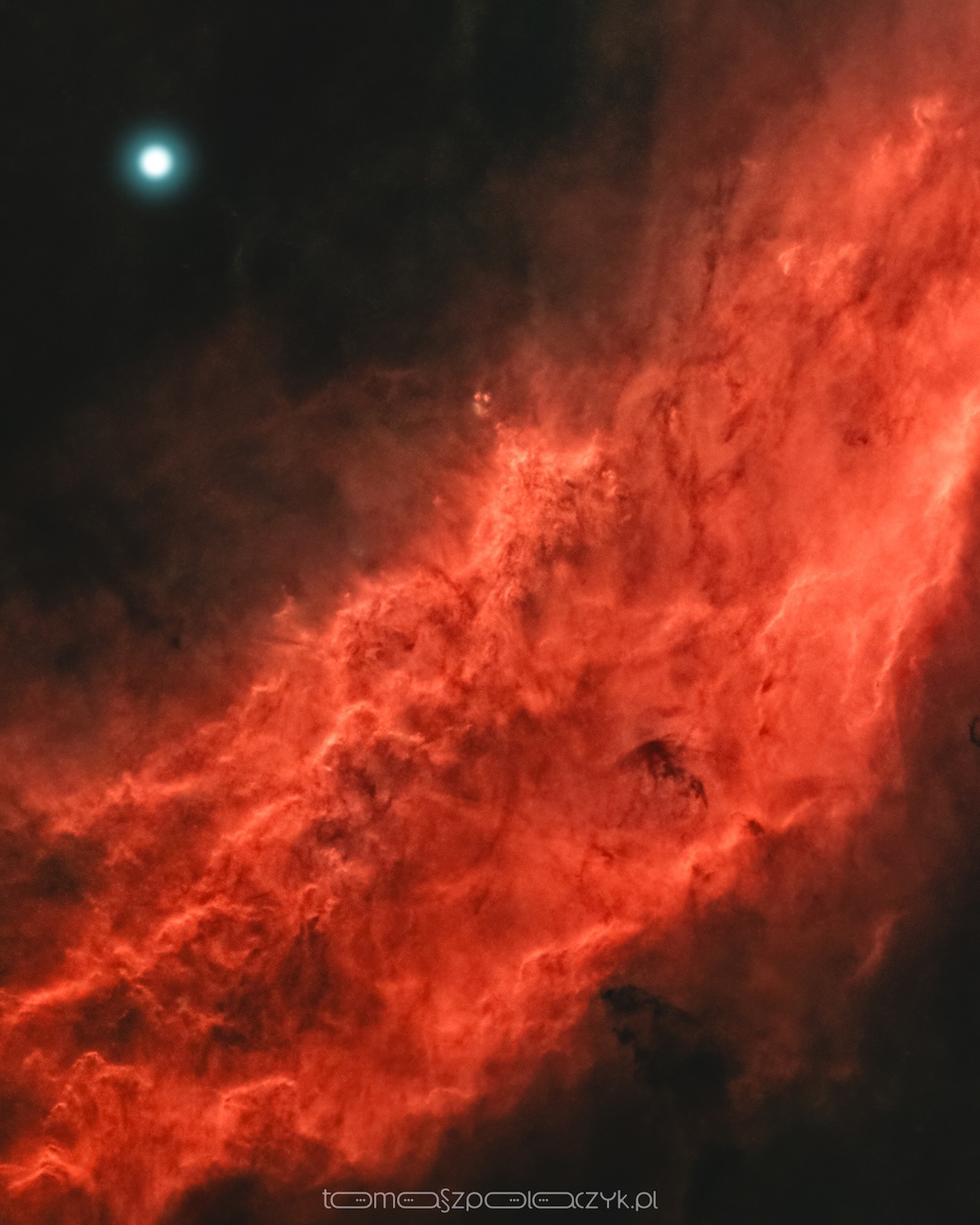
An emission nebula located in the constellation Perseus, approximately 1,500 light-years from Earth.
The bright star above the nebula is Menkib – ξ Persei. Its diameter is approximately 14 times that of our Sun, measuring around 20 million km. Its blue-white color results from its extremely high surface temperature of approximately 37,000 K (36,700°C), compared to just 5,800 K (5,500°C) for our Sun.
The ultraviolet radiation emitted by Menkib ionizes hydrogen in the nearby nebula. When electrons recombine with protons, the gas emits light, including the red hydrogen Hα emission line, which gives the California Nebula its characteristic color.
In the lower-right corner of the frame, you can see dark dust nebulae from the LDN catalog (Lynds’ Catalogue of Dark Nebulae) — LDN 1462, 1463, and 1464, respectively. Their estimated sizes range from approximately 2 to 5 light-years, comparable to the distance separating us from the nearest star system, Alpha Centauri (approximately 4.37 light-years). These enormous clouds of dust absorb light from objects behind them, creating dark structures against the glowing nebula.
Equipment & Acquisition
• Telescope: @sharpstaroptics Askar 71F
• Focal length: 490 mm
• Camera: @zwoastro ZWO ASI2600MC Pro
• Mount: ZWO AM5N
• Filters: @svbony.website SV240 and UHC
• Filter wheel: ZWO EFW
• Focuser: ZWO EAF
• Guiding: ZWO OAG-L + ZWO ASI220MM Mini
• Control: ZWO ASIAIR Plus 256 GB
• Acquisition: 570 × 300 s exposures, collected since early August 2026.
• Total integration time: 47 hours and 30 minutes, with dithering every 2 frames. The long total integration time allowed me to achieve a very low noise level after stacking, while dithering helped reduce fixed-pattern noise.
• Conditions: Urban skies, varying between Bortle 6–8. For about a month, a nearby malfunctioning streetlight at the town hall was shining directly into my telescope — fortunately, it's finally been fixed! ☺️
• Processing: PixInsight and Photoshop
• Focal length: 490 mm
• Camera: @zwoastro ZWO ASI2600MC Pro
• Mount: ZWO AM5N
• Filters: @svbony.website SV240 and UHC
• Filter wheel: ZWO EFW
• Focuser: ZWO EAF
• Guiding: ZWO OAG-L + ZWO ASI220MM Mini
• Control: ZWO ASIAIR Plus 256 GB
• Acquisition: 570 × 300 s exposures, collected since early August 2026.
• Total integration time: 47 hours and 30 minutes, with dithering every 2 frames. The long total integration time allowed me to achieve a very low noise level after stacking, while dithering helped reduce fixed-pattern noise.
• Conditions: Urban skies, varying between Bortle 6–8. For about a month, a nearby malfunctioning streetlight at the town hall was shining directly into my telescope — fortunately, it's finally been fixed! ☺️
• Processing: PixInsight and Photoshop
You're looking at two versions: one with stars and another with only Menkib left visible (the so-called starless version).
And a third version in the XPan format — this one's going to print! 🎇😍
Equipment supplied by the always reliable @teleskopy and @deltaoptical.pl
______________________________________________________________________________________________
Mgławica Kalifornia - NGC 1499
Mgławica emisyjna w gwiazdozbiorze Perseusza, oddalona od Ziemi o około 1500 lat świetlnych.
Jasna gwiazda nad mgławicą to Menkib - ξ Persei. Jej średnica jest około 14 razy większa niż średnica naszego Słońca, czyli wynosi około 20 mln km. Niebieskobiała barwa wynika z bardzo wysokiej temperatury powierzchni - około 37 000 K (36 700°C), gdzie nasze Słońce to tylko okolo 5800 K (5500°C).
Emitowany przez Menkiba ultrafiolet jonizuje wodór w pobliskiej mgławicy. Gdy elektrony ponownie łączą się z protonami, gaz emituje światło, w tym czerwoną linię wodoru Hα, która nadaje Kalifornii charakterystyczną barwę.
W dolnym prawym rogu kadru widać ciemne mgławice pyłowe z katalogu LDN (Lynds’ Catalogue of Dark Nebulae) - odpowiednio LDN 1462,1463 i 1464. Ich szacowana wielkość wynosi od około 2 do 5 lat świetlnych, czyli jest porównywalna z odległością dzielącą nas od najbliższego układu gwiazd - Alfa Centauri (około 4,37 roku świetlnego). Te ogromne obłoki pyłu pochłaniają światło znajdujących się za nimi obiektów, tworząc ciemne struktury na tle mgławicy.
• Teleskop: @sharpstaroptics Askar 71F
• Ogniskowa: 490 mm
• Kamera: @zwoastro ZWO ASI2600MC Pro
• Montaż: ZWO AM5N
• Filtry: @svbony.website SV240 i UHC
• Koło filtrowe: ZWO EFW
• Ostrość: ZWO EAF
• Guiding: ZWO OAG-L + ZWO ASI220MM Mini
• Sterowanie: ZWO ASIAIR Plus 256 GB
• Materiał: 570 × 300 s, zbierany od początku sierpnia 2026 r.
• Łączny czas ekspozycji: 47 godz. 30 min, dithering co 2 klatki. Długi łączny czas zbierania światła pozwolił uzyskać bardzo niski poziom szumu po połączeniu materiału, a dithering pomógł ograniczyć jego stałe wzory.
• Warunki: miejskie, zmienne - Bortle 6–8. Przez około miesiąc pobliska, uszkodzona lampa ratuszowa świeciła mi wprost w teleskop - na szczęście jest już naprawiona ☺️
• Obróbka: PixInsight i Photoshop
Widzicie dwie wersje: z gwiazdami oraz z pozostawionym tylko Menkibem (tzw. starless)
Oraz trzecią, w formacie XPan - idzie w druk 🎇😍
Sprzęt od niezawodnych: @teleskopy i @deltaoptical.pl
Mgławica emisyjna w gwiazdozbiorze Perseusza, oddalona od Ziemi o około 1500 lat świetlnych.
Jasna gwiazda nad mgławicą to Menkib - ξ Persei. Jej średnica jest około 14 razy większa niż średnica naszego Słońca, czyli wynosi około 20 mln km. Niebieskobiała barwa wynika z bardzo wysokiej temperatury powierzchni - około 37 000 K (36 700°C), gdzie nasze Słońce to tylko okolo 5800 K (5500°C).
Emitowany przez Menkiba ultrafiolet jonizuje wodór w pobliskiej mgławicy. Gdy elektrony ponownie łączą się z protonami, gaz emituje światło, w tym czerwoną linię wodoru Hα, która nadaje Kalifornii charakterystyczną barwę.
W dolnym prawym rogu kadru widać ciemne mgławice pyłowe z katalogu LDN (Lynds’ Catalogue of Dark Nebulae) - odpowiednio LDN 1462,1463 i 1464. Ich szacowana wielkość wynosi od około 2 do 5 lat świetlnych, czyli jest porównywalna z odległością dzielącą nas od najbliższego układu gwiazd - Alfa Centauri (około 4,37 roku świetlnego). Te ogromne obłoki pyłu pochłaniają światło znajdujących się za nimi obiektów, tworząc ciemne struktury na tle mgławicy.
• Teleskop: @sharpstaroptics Askar 71F
• Ogniskowa: 490 mm
• Kamera: @zwoastro ZWO ASI2600MC Pro
• Montaż: ZWO AM5N
• Filtry: @svbony.website SV240 i UHC
• Koło filtrowe: ZWO EFW
• Ostrość: ZWO EAF
• Guiding: ZWO OAG-L + ZWO ASI220MM Mini
• Sterowanie: ZWO ASIAIR Plus 256 GB
• Materiał: 570 × 300 s, zbierany od początku sierpnia 2026 r.
• Łączny czas ekspozycji: 47 godz. 30 min, dithering co 2 klatki. Długi łączny czas zbierania światła pozwolił uzyskać bardzo niski poziom szumu po połączeniu materiału, a dithering pomógł ograniczyć jego stałe wzory.
• Warunki: miejskie, zmienne - Bortle 6–8. Przez około miesiąc pobliska, uszkodzona lampa ratuszowa świeciła mi wprost w teleskop - na szczęście jest już naprawiona ☺️
• Obróbka: PixInsight i Photoshop
Widzicie dwie wersje: z gwiazdami oraz z pozostawionym tylko Menkibem (tzw. starless)
Oraz trzecią, w formacie XPan - idzie w druk 🎇😍
Sprzęt od niezawodnych: @teleskopy i @deltaoptical.pl